Can Your Headache Come From Your Neck?

When we think of headaches, most of us think of migraine or stress. Yet in a considerable proportion of people with chronic, recurring headaches, the real source of the pain is the neck — by some estimates up to one in five of those with chronic headaches. This pattern, which starts at the back of the neck and spreads to the back of the head, and even to the forehead or around the eye, is called cervicogenic (neck-related) headache. Its most important feature is this: because the source is the neck, it is often a type of headache that genuinely responds to physiotherapy. So could yours be this kind?
What Is Neck-Related Headache?
Cervicogenic headache is defined in international classifications as a “secondary headache” — that is, not a disease in its own right, but a pain that arises as a result of a mechanical problem in the neck. You feel the pain in your head, but its real source is in the neck. This distinction matters greatly for treatment: because if the source is the neck, so is the solution.
Why Does a Problem in the Neck Cause Head Pain? The Role of the Upper Cervical Region
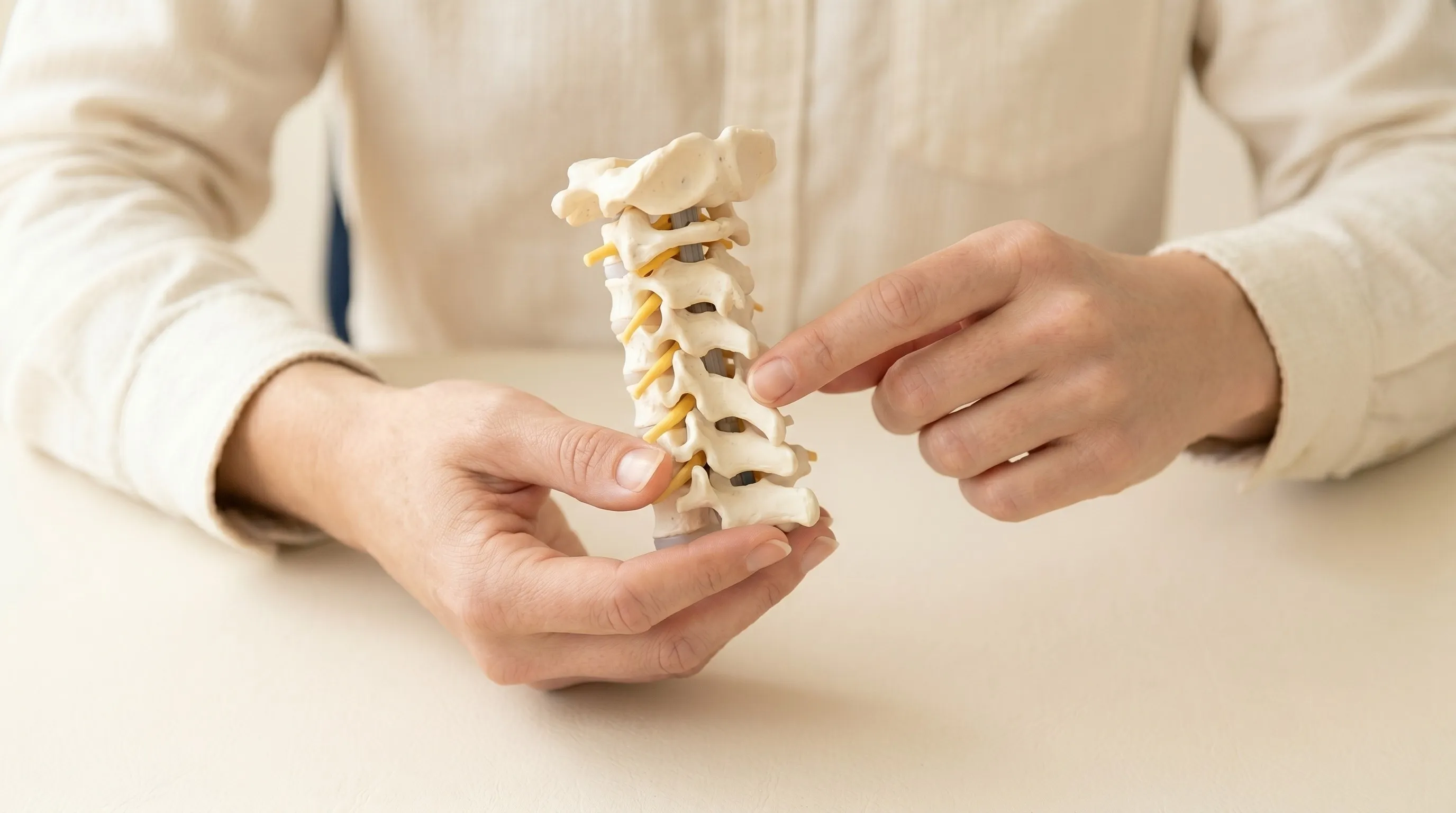
So how does a problem in the neck cause head pain? The reason is that the nerves of the upper neck and the nerves supplying the head meet at the same “junction” in the brainstem. The brain sometimes perceives a signal from the neck as if it were coming from the head — which is why the pain can start at the back of the neck and spread to the back of the head, the temple or the forehead. This is why a problem whose source is in the neck can present itself as a headache.
So where does this pain most often arise? Research shows that in around 70% of cervicogenic headache cases the source is the small joint between the second and third neck vertebrae (the C2-3 facet joint). Alongside this, the deep muscles at the back of the neck just below the skull, the upper neck joints and the nerves there also contribute.
How Is It Told Apart? The Difference From Migraine and Tension-Type Headache
Telling headache types apart can be difficult, and they can overlap; but neck-related headache has some typical features:
- It is usually one-sided and tends to stay on the same side.
- It starts at the back of the neck or head and spreads forward (forehead, temple, around the eye).
- It is triggered by neck movements or sustained postures — such as looking at a screen for a long time or staying in one position.
- It comes with neck stiffness and restricted movement; in some people, pressure over the neck reproduces the familiar pain.
By contrast, migraine is usually throbbing and comes with nausea or sensitivity to light and sound; tension-type headache is usually on both sides and gives a “tightening band” sensation. This distinction is not always clear, and the types can sometimes occur together — which is why a definitive assessment is made through examination.
Why Does Physiotherapy Matter Here?
What sets neck-related headache apart from the others is this: because its source is mechanical, treatment directed at that source genuinely helps. Indeed, the scientific literature includes strong studies showing that, for this condition, combining manual therapy with motor control exercises for the neck muscles is effective — and, perhaps more importantly, that this effect is maintained in the long term.
Physiotherapy works in two ways here. On the one hand, it addresses the movement of the upper neck joints and the tension in the muscles; on the other, it uses techniques that support the nerves’ ability to move freely and adapt to tension, reducing the basis for referred pain. The aim is not merely to suppress the pain, but to address the movement and tension problem at its source.
The approach here is a familiar one: first, a proper assessment to determine whether the pain really does come from the upper neck; then, addressing the restricted joints and the deep neck muscles that are working poorly in a targeted way — so that both the intensity and the frequency of the attacks can be reduced.
When Must You See a Doctor?
Not every headache is neck-related or harmless. In the following situations the priority is not physiotherapy but prompt medical assessment: a headache that comes on suddenly and that you would describe as “the worst of my life”; if it is accompanied by fever, a stiff neck, blurred vision, difficulty speaking or weakness in an arm or leg; if the headache is steadily worsening or changing in character; or if it appears after a head injury. These are not features of neck-related headache and must be assessed by a doctor.
Otherwise, for long-standing headaches that appear to be linked to the neck, an assessment is a good starting point for finding out whether the source really is the neck. Approaches to neck pain and stiffness are covered on a separate page.
References
- Bogduk N, Govind J. Cervicogenic headache: an assessment of the evidence on clinical diagnosis, invasive tests, and treatment. Lancet Neurol. 2009;8(10):959–968.
- Jull G, Trott P, Potter H, et al. A randomized controlled trial of exercise and manipulative therapy for cervicogenic headache. Spine. 2002;27(17):1835–1843.
- Sjaastad O, Fredriksen TA, Pfaffenrath V. Cervicogenic headache: diagnostic criteria. Headache. 1998;38(6):442–445.
- Headache Classification Committee of the International Headache Society (IHS). The International Classification of Headache Disorders, 3rd edition. Cephalalgia. 2018.
Frequently Asked Questions
How is neck-related headache told apart from migraine?
Neck-related headache is usually one-sided, starts at the back of the neck and is triggered by neck movements; migraine is often throbbing and comes with nausea and sensitivity to light and sound. A definitive distinction is made through examination.
Can neck-related headache be resolved with physiotherapy?
Because its source is mechanical, it responds well to treatment. The literature shows that combining manual therapy with neck exercises is effective and that the effect is maintained in the long term.
Can I come straight to physiotherapy for my headache?
For headaches that appear linked to the neck, an assessment is a good starting point; however, if there is a sudden very severe headache, fever, neurological signs or pain after trauma, the priority is medical assessment.
You can book an appointment to assess your neck and discuss suitable treatment options.
Related Posts

Waking Up With a Stiff Neck: Why It Happens and What to Do
Why do you wake up with a stiff neck, and what should you do? Causes, what helps at home, and the signs that mean it's time for an assessment.
Neck Pain in Desk Workers
Why neck pain happens in desk workers, whether 'text neck' is real, what you can do about it, and how physiotherapy can help. Practical, evidence-based tips.

What Is Mechanical Low Back Pain? A Physiotherapist's Complete Guide
Most back pain is 'mechanical' and not due to serious damage. The causes, natural course, why an MRI is usually unnecessary, and how physiotherapy helps.
This content is for informational purposes only. It is not intended as medical advice. Please consult your physician and physiotherapist for any health concerns.