Does a Rotator Cuff Tear Need Surgery?
When an imaging scan or an examination reveals “a tear in the rotator cuff”, the first question that comes to mind is usually the same: is surgery essential, or can I get through this without it? There is no single, quick answer — because a “rotator cuff tear” is not one single condition. How the tear happened, its size and your day-to-day needs together determine whether surgery is necessary. In this article we look at when the non-surgical route is realistic, what physiotherapy aims for, and when surgery comes into the picture.
First, let’s be clear: what does “recovery” mean?
A torn tendon is not expected to spontaneously re-attach and regain its former integrity. So the plain answer to “does the tear close on its own?” is no. But for most people, what really matters is not how the tendon looks on a scan, but whether the shoulder is pain-free and functional. In this second sense, “recovery” — less pain, returning strength and movement — is possible without surgery for a great many tears. So the right question is not “will the tear close?” but “can this shoulder work well again without surgery?”
The most important distinction: traumatic or degenerative?
This distinction largely determines the path to follow.
Degenerative (wear-related) tears develop over years, without any obvious accident; they become more common with age and sometimes cause no symptoms at all. For this type of tear the first choice is usually conservative treatment — that is, physiotherapy. Research shows that around three in four people with an atraumatic tear can avoid surgery with a structured physiotherapy programme.
It may sound surprising, but rotator cuff tears — particularly beyond a certain age — are remarkably common and very often cause no symptoms at all. More than half of people over sixty will show a cuff tear if imaging is done — yet most of them use their shoulder without any trouble. So a “tear” seen on an MRI or ultrasound does not, on its own, mean surgery is needed. What matters is not the presence of the tear, but whether it is causing pain, weakness and loss of function.
Traumatic tears, by contrast, appear with a sudden event: a fall, or a movement that abruptly overloads the arm. Particularly in younger, active people, when there is a distinct tear that has developed suddenly, the current approach is for them to seek a surgical opinion without losing time. This is because delay in this type of tear can lead to irreversible changes in the muscle (wasting, fatty infiltration). Here, “let’s wait and see first” is not always right.
The non-surgical route: what does physiotherapy aim for?
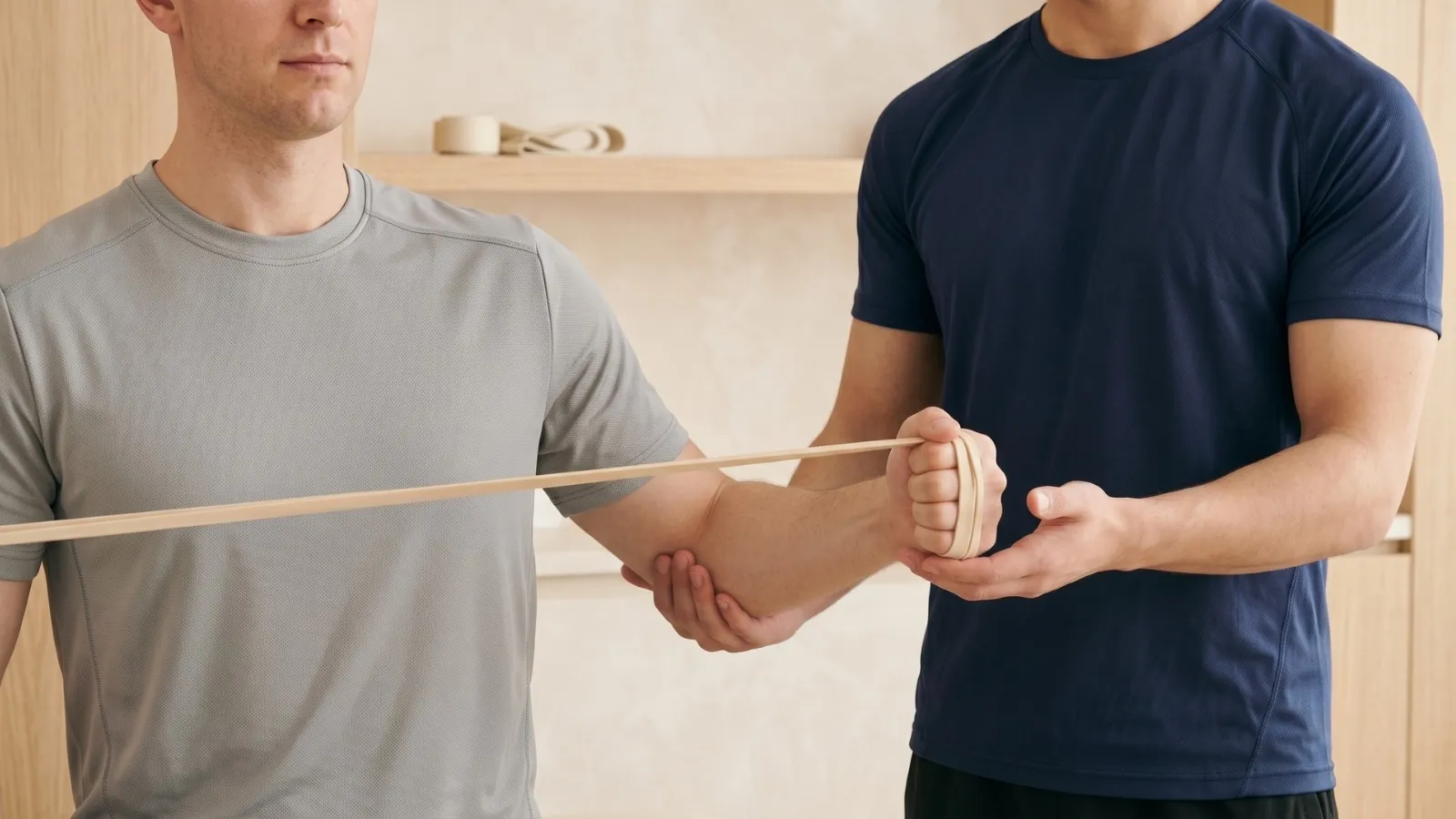
Non-surgical treatment does not “stitch” the tear itself — but most of the time it doesn’t need to. The aim is to strengthen the intact muscles around the shoulder and its movement control, so that the shoulder works painlessly and functionally even with a tear. Indeed, particularly in degenerative (age-related, gradually developing) tears, physiotherapy can deliver outcomes comparable to surgery in many cases.
In practice this means progressive strengthening of the intact cuff muscles and the muscles that control the shoulder blade, restoring range of motion and managing pain. The evidence shows that progressive resistance exercises performed two to three times a week provide the most consistent improvement in pain and function; manual therapy and movement work support this process.
When does surgery come into the picture?
First, this needs to be said plainly: the decision for surgery is one for a surgeon to make, assessing the person as a whole — the purpose of this article is not to direct that decision. That said, the general trend in the literature is this: for the great majority of rotator cuff tears — particularly age-related (degenerative) and partial tears — the first choice is usually non-surgical treatment. Research indicates that surgery tends to come into the picture in specific situations — for example, a large full-thickness tear caused by a sudden trauma in a younger person, or marked weakness and loss of function persisting despite months of conservative treatment. For many people outside these situations, a structured physiotherapy programme is often the first and sufficient step.
In either case, physiotherapy is an important part of the process: as the main approach in non-surgical management, and as a component supporting recovery both before and after when surgery is involved.
So, which one am I?
The answer to these questions varies from person to person; because without assessing the type and size of the tear together with your needs, no one can say which route suits you. A physiotherapy assessment clarifies whether the tear is traumatic or degenerative, to what extent strength is affected, and whether you are a suitable candidate for conservative treatment. That way, rather than “waiting and seeing”, you move forward knowing the route that suits you. (You can also look at the possible causes of shoulder pain according to where in the movement it appears on the Shoulder Problems page.)
References
- StatPearls / Physiopedia — Rotator Cuff Tears.
- AAOS Clinical Practice Guideline (2025) — Rotator Cuff Injuries.
- JOSPT Systematic Review (2024) — Exercise for rotator cuff tears.
- Conservative vs. Surgical Management of Degenerative Rotator Cuff Tears — Systematic Review & Meta-analysis (2021).
- British Elbow & Shoulder Society / BOA — traumatic vs non-traumatic pathway.
- Management of degenerative rotator cuff tears: a review (PMC).
- Conservative management of degenerative rotator cuff tears — systematic review (2026).
Frequently Asked Questions
Can a rotator cuff tear get better without surgery?
A torn tendon doesn't re-attach on its own — but for most people that isn't the real issue. Less pain, returning strength and movement — the shoulder working well again — is possible without surgery for a great many tears, through physiotherapy.
Is it harmful to exercise with a tear?
When planned correctly, no. Progressive strengthening of the intact muscles is the foundation of the non-surgical approach. The type and intensity of exercise are set according to the state of the tear.
If I delay surgery, will the tear get bigger?
With degenerative tears, controlled monitoring is often possible. But with traumatic tears, particularly in younger people, delay can lead to changes that are hard to reverse; this is why an early opinion matters here.
How long does non-surgical treatment take?
It varies from person to person; it is usually a structured process of a few months. If there is no improvement in that time, the surgical option is reconsidered.
You can book an appointment to assess your shoulder and discuss suitable treatment options.
Related Posts

What Is Shoulder Impingement Syndrome?
Why does lifting your arm hurt? Shoulder impingement, the painful arc, the surgery debate and physiotherapy's role — an evidence-based look from Beşiktaş.

Why Does Shoulder Pain Get Worse at Night?
Why does shoulder pain flare at night and worsen lying on that side? The mechanism behind night pain, which conditions cause it, and how physiotherapy helps.

How Long Does Frozen Shoulder Last?
How long does frozen shoulder last? The freezing, frozen and thawing stages, recovery time and the role of physiotherapy — an evidence-based look from Beşiktaş.
This content is for informational purposes only. It is not intended as medical advice. Please consult your physician and physiotherapist for any health concerns.