What Is Shoulder Impingement Syndrome?

A sharp pain that appears at a particular point as you lift your arm out to the side or overhead may be a sign of one of the most common shoulder presentations: “shoulder impingement”. For many years this pain was explained by tendons being “pinched” in a narrow space beneath the roof of the shoulder. Current science, however, shows that neither the name nor the simple mechanical explanation behind it is as clear-cut as once thought. This article looks at what shoulder impingement is, why it happens and what actually helps.
What is shoulder impingement?
Shoulder impingement syndrome is a pain presentation associated with irritation of the structures that sit in the narrow space between the roof of the shoulder (the acromion) and the arm bone — the rotator cuff tendons and a small cushion called the bursa. It is one of the most common causes of atraumatic shoulder pain — pain that develops without any obvious accident. Its classic sign is pain that appears within a certain range as you lift the arm out to the side, usually felt at the front-outer part of the shoulder; it can worsen with overhead movements, when reaching for something, or when lying on that arm.
Is “impingement” really the right name?
Honesty is needed here: the term “impingement” has been seriously debated in recent years. The long-dominant model of “bone pressing on tendon” has come under question, both in theory and in practice. Many researchers now think this presentation is not just a single mechanical “pinch”; the health and load capacity of the tendon itself, the way the muscles around the shoulder work, and the movement of the shoulder blade are all part of the picture. This is why the literature increasingly prefers names such as “subacromial pain syndrome” or “rotator cuff related shoulder pain”. Why does this matter? Because the thought “something is pinched, so it must be released” often creates an expectation of unnecessary intervention — when the condition is usually far more manageable than that.
Why does lifting the arm hurt?
The most typical sign is the “painful arc”: pain appears as you lift the arm out to the side, roughly between 60 and 120 degrees, and eases as the arm goes higher. The reason is simple: within exactly this range the space the tendons pass through is at its narrowest, and it opens up again as the arm rises.
But there is a dimension that is often missed here: the problem is not always the “narrow space” itself, but how that space is used. The shoulder blade makes room for the tendons by moving with the right timing as the arm lifts; when this harmony is disturbed, or the muscles around the shoulder work out of balance, the head of the arm bone can drift upwards and narrow the space further. This is why shoulder impingement is most often resolved not by “changing the shape of the bone”, but by re-organising movement and balance — which is exactly what physiotherapy and manual therapy aim to do.
How is it treated? Is surgery necessary?
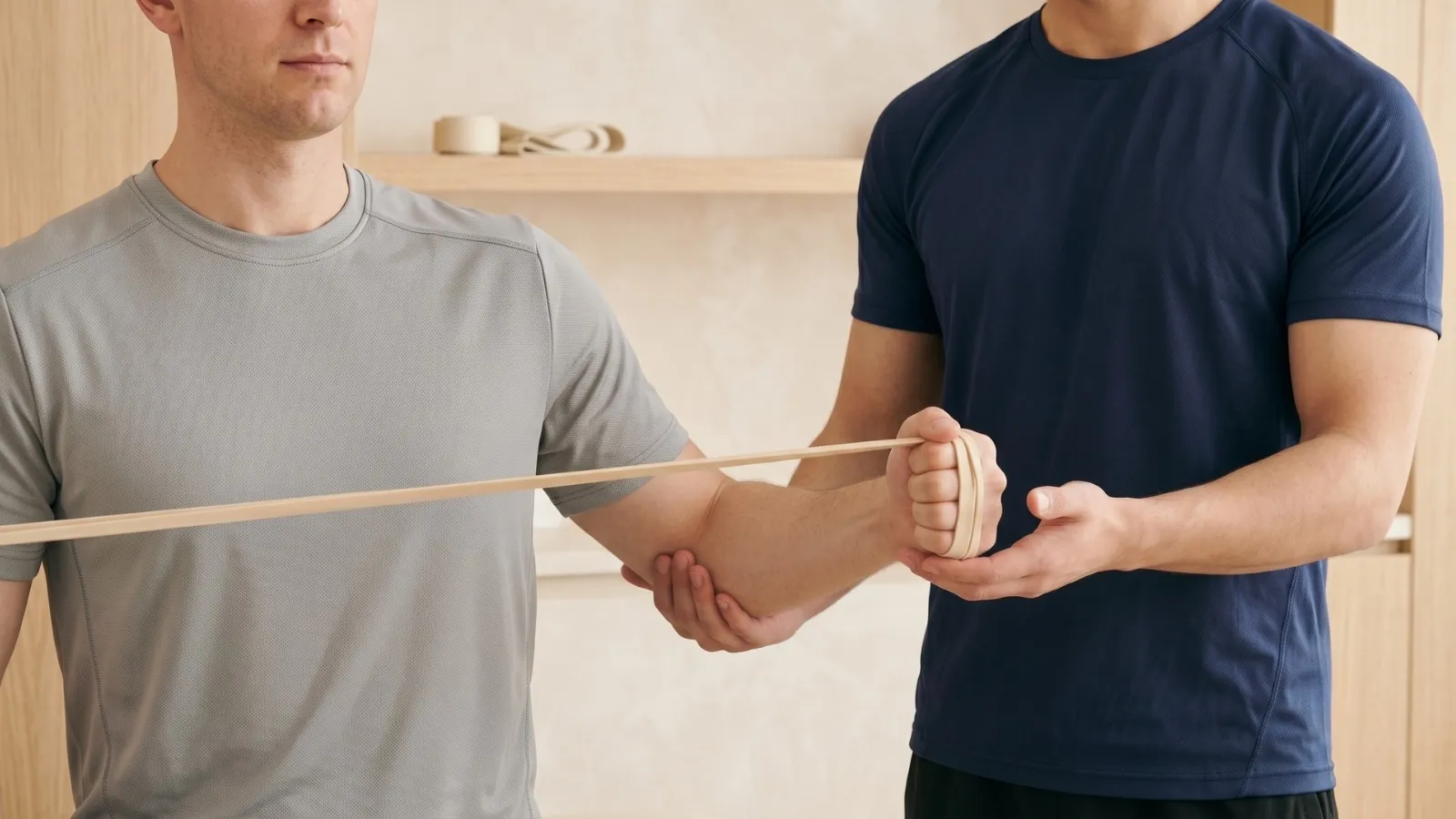
In shoulder impingement the first choice is almost always the non-surgical route, and the evidence supports this strongly. The core treatment here is physiotherapy: progressive strengthening of the rotator cuff and the muscles that control the shoulder blade, improving movement quality, and restoring the shoulder’s movement harmony with manual therapy. Research shows that the great majority of patients improve markedly with a properly structured physiotherapy programme.
What about surgery? There is a striking finding here: high-quality studies have shown that “subacromial decompression” — the operation commonly performed for shoulder impingement — gives no better results than sham (placebo) surgery or physiotherapy. In other words, “shaving” the roof of the shoulder does not provide the expected added benefit for most patients. The decision for surgery is, of course, a surgeon’s to make, and the purpose of this article is not to direct it; but the general trend in the literature is that in this presentation, physiotherapy is the first and often sufficient step.
When should you have an assessment?
If your shoulder pain has not eased for several weeks, is disturbing your sleep or is making it increasingly hard to lift your arm, a physiotherapy assessment clarifies what the presentation is and which programme suits you. Pain that appears after a sudden trauma, or that comes with marked weakness (being unable to lift or hold the arm), calls for earlier assessment. For an overview of this and other shoulder structures, see the Shoulder Problems page.
References
- Subacromial Pain Syndrome — Physiopedia.
- JOSPT (2020) — Conservative management of subacromial shoulder pain (systematic review).
- CSAW trial (Beard et al., Lancet 2018) — Subacromial decompression vs placebo/physiotherapy.
- JOSPT Clinical Practice Guideline (2025) — Rotator cuff tendinopathy.
Frequently Asked Questions
Are shoulder impingement and a rotator cuff tear the same thing?
No. Shoulder impingement is a pain presentation involving irritation of the tendon and the structures around it, whereas a rotator cuff tear is a partial or complete tear of the tendon. The two can be related, but they are different conditions; which one is present becomes clear through assessment.
Does shoulder impingement need surgery?
Usually not. High-quality evidence shows that the commonly performed decompression operation is not superior to physiotherapy. The first and often sufficient step is a structured physiotherapy programme.
Should I stop using my painful arm altogether?
No. Keeping the arm completely still is not recommended; the aim is to keep using it within tolerable limits of pain, and to strengthen it with the right loading.
Is a cortisone injection the answer?
A corticosteroid injection can reduce pain in the short term in some situations, but on its own it is not a lasting solution. Some studies also suggest corticosteroids may weaken tendon tissue and leave the area somewhat more open to a possible tear; although how certain this effect is in humans remains unclear, injections should be used cautiously. The real benefit comes from a physiotherapy programme built on manual therapy and therapeutic exercise.
You can book an appointment to assess your shoulder and discuss suitable treatment options.
Related Posts
Does a Rotator Cuff Tear Need Surgery?
Can a rotator cuff tear recover without surgery? Traumatic vs degenerative tears, physiotherapy's role and when surgery is advised — from Beşiktaş.

Why Does Shoulder Pain Get Worse at Night?
Why does shoulder pain flare at night and worsen lying on that side? The mechanism behind night pain, which conditions cause it, and how physiotherapy helps.

How Long Does Frozen Shoulder Last?
How long does frozen shoulder last? The freezing, frozen and thawing stages, recovery time and the role of physiotherapy — an evidence-based look from Beşiktaş.
This content is for informational purposes only. It is not intended as medical advice. Please consult your physician and physiotherapist for any health concerns.