What Is Lumbar Spinal Stenosis? A Physiotherapist's Complete Guide

If you feel pain, numbness or heaviness in your legs after walking a little, and it eases when you sit down or bend forward, lumbar spinal stenosis could be behind it. Seeing “spinal stenosis” or “canal narrowing” on an MRI report can be frightening; yet this is a condition that can usually be managed without surgery and with the right physiotherapy approach. In this article we take a comprehensive look at what lumbar spinal stenosis is, why it produces such a typical “worse with walking” pain, how it differs from sciatica, and the central role of physiotherapy here.
What is lumbar spinal stenosis?
The spine has a canal through which the nerves pass. Lumbar spinal stenosis is a narrowing of this canal, or of the side channels where the nerves exit, leaving less room for the nerves passing through. The narrowing can be in the middle of the canal (central), in the area where the nerve exits towards the corner (lateral recess), or in the opening where it leaves the vertebra (foraminal). This pressure on the nerves causes symptoms, particularly in certain positions. The key point is this: although the word “narrowing” sounds serious, it is usually a slow-developing and largely manageable condition.
Why does it happen?
The most common cause of lumbar spinal stenosis is the natural wear that develops in the spine with age. Over time, the discs between the vertebrae lose height, the joints enlarge (thicken) and the ligaments thicken, slowly narrowing the canal. This is why lumbar spinal stenosis is seen most often from middle age onwards. Less commonly, having a congenitally narrow canal or other spinal conditions can also contribute to the picture. In other words, stenosis is usually not a sudden “injury” but a gradual change brought on by the years.
What are the symptoms? (Leg pain that worsens with walking)
The most typical symptom of lumbar spinal stenosis is a specific pattern called “neurogenic claudication”: pain, numbness, tingling or heaviness in the legs (buttocks, thighs, calves) that comes on with walking or prolonged standing. These symptoms are often bilateral, and after walking for a while the person has to stop and sit or bend forward — because this markedly relieves the symptoms. Back pain may also accompany it, but in most people the real problem is these “worse with walking, better with sitting” leg symptoms.
Why does bending forward relieve it and standing worsen it?
This is the most characteristic and most revealing aspect of the condition. When you arch your back backwards or stand upright, the spinal canal narrows; when you bend forward or sit, the canal widens and opens up more room for the nerves. This effect is very pronounced in a narrow canal: studies show that in a narrowed spine, bending backwards markedly reduces the canal area, while bending forward visibly increases it. This is exactly why people with stenosis are more comfortable leaning on a shopping trolley or walking bent forward, and may prefer cycling (a naturally forward-leaning position) to walking. This “posture dependence” is both an important diagnostic clue and the basic logic of treatment.
How is it different from sciatica?
Lumbar spinal stenosis and sciatica are often confused, because both cause symptoms that radiate into the leg. But there are important differences. Sciatica is usually one-sided and spreads as a sharp pain along a single nerve path; it often worsens when sitting or bending forward. Lumbar spinal stenosis, by contrast, is usually bilateral, comes on with walking and, the other way around, eases with sitting or bending forward. This distinction is not always clear-cut and the two can coexist; that is why the correct distinction becomes clear through a careful assessment. For detailed information on sciatica, another common cause of leg pain, you can read our article What Is Sciatica?.
What does “narrowing” on an MRI mean?
There is an important fact here: the degree of narrowing on an MRI does not, on its own, determine the severity of the symptoms you will experience. Interestingly, some studies have shown that people with moderate narrowing can have more symptoms than those with very advanced narrowing. What is more, the severity of radiological narrowing also does not determine how well a person will respond to physiotherapy — people with narrowing at every level can benefit from exercise. This is why the treatment decision is made according to the person’s real symptoms and function, not the image alone.
How is it assessed in physiotherapy?
The aim in physiotherapy is to understand whether the symptoms are truly due to canal narrowing, and to distinguish the picture from conditions that look similar (for example, leg pain due to a blocked blood vessel). The assessment examines the pattern of symptoms (when they start, in which position they ease, how far you walk before they appear), walking capacity, the movement of the back and hip, and nerve function. This assessment forms the basis for both an accurate diagnosis and an individualised programme.
How is it treated?
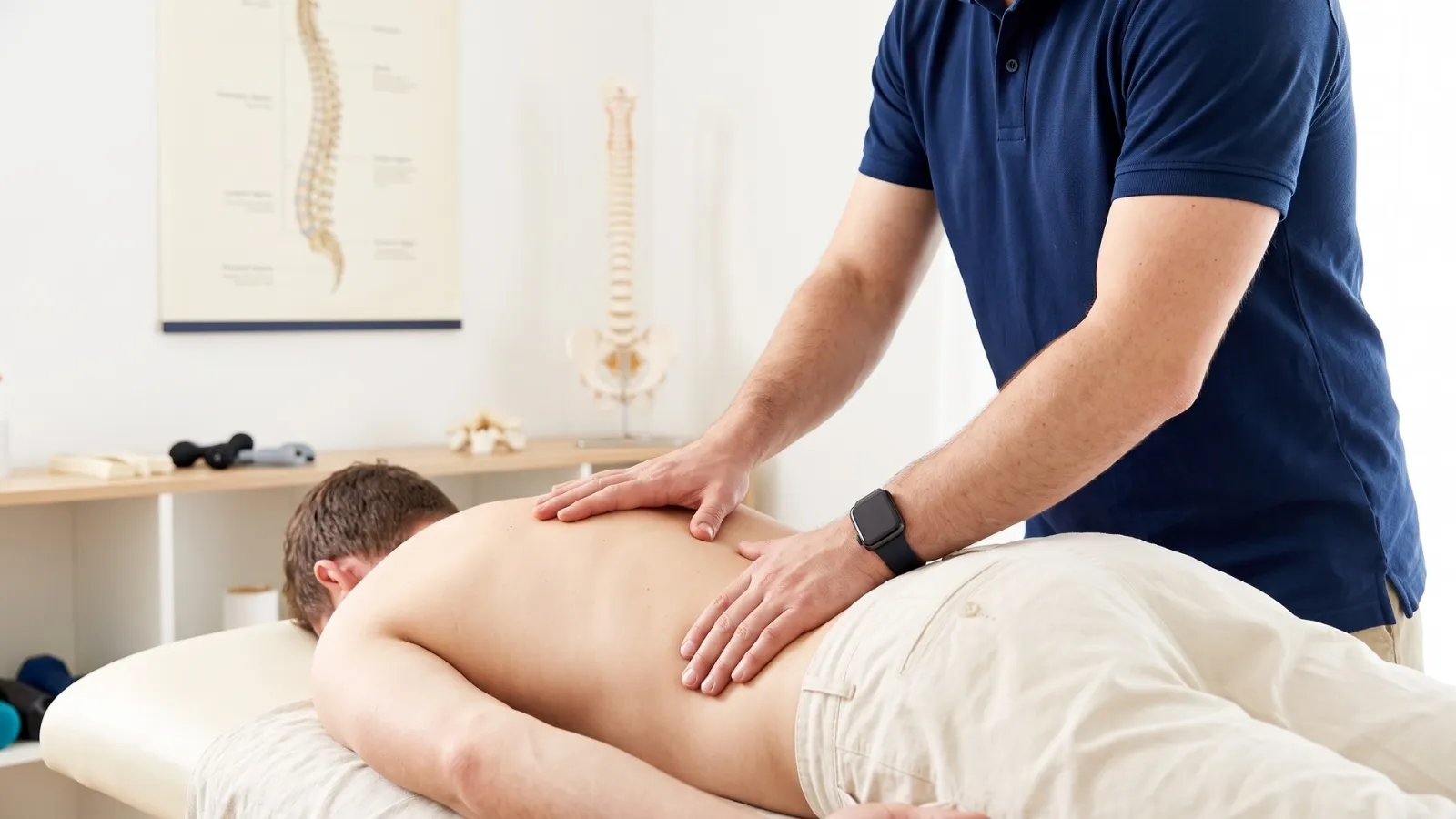
In lumbar spinal stenosis, physiotherapy is an evidence-supported approach that makes a marked difference for most people. Current reviews show that supervised, multimodal physiotherapy programmes reduce pain and increase walking distance and function. At the foundation of this programme are forward-bending (flexion) exercises that open up the canal. This is accompanied by work to strengthen the core and back muscles, exercises to improve hip movement (because hip stiffness can make the back arch backwards more while walking and worsen the symptoms), manual therapy, and a programme that gradually increases walking capacity. Cycling and water-based exercise are also frequently recommended, because they naturally offer easing positions. The aim is not to “open” the narrowing — which is not the goal of physiotherapy — but to allow the person to move for longer, more comfortably and with less pain. For a general overview of the lower back and the treatment approach, you can see the Lower Back Pain page.
What to avoid and what to watch for
In lumbar spinal stenosis, avoiding some symptom-worsening situations makes daily life markedly easier. Holding the back arched backwards (upright and tense) for long periods, standing still for a long time, and especially walking downhill (which arches the back backwards) can trigger the symptoms. In contrast, it helps to take short breaks to sit while walking, to break up long distances, and to know that slightly forward-leaning positions provide relief. These are not permanent restrictions, but practical ways to manage the symptoms and preserve walking capacity.
How are exercises chosen?
In lumbar spinal stenosis, exercise is chosen according to the person’s symptoms, walking capacity and what they can tolerate. The general tendency is to focus on canal-opening, forward-bending movements and on work that increases walking tolerance; movements that over-arch the back are usually avoided. But even this general framework is tailored to the person; the exercise programme is based on the assessment and is updated over the course of the process according to the person’s response.
What is the natural course?
The natural course of lumbar spinal stenosis is not as bad as feared. The symptoms usually do not worsen suddenly and rapidly over the years; with an appropriate approach, many people manage their symptoms and maintain an active life for years. The anatomical narrowing itself usually does not disappear, but the symptoms can become markedly more manageable with posture adjustment, exercise, activity planning and weight management. In some people the symptoms may increase over time; in that case, too, the approach is re-tailored according to the person’s function and quality of life.
When is surgery considered?
In lumbar spinal stenosis, the first and often sufficient approach is conservative treatment. Surgery generally comes onto the agenda in a specific situation: when, despite an appropriate conservative treatment applied for an adequate period, walking distance and quality of life are seriously restricted, or when there is a marked, progressive nerve symptom. In lumbar spinal stenosis, surgery is usually not an emergency but a planned option aimed at improving quality of life and function. This assessment is made by a doctor who sees the whole person. The aim of this article is not to direct your care, but to show how valuable the conservative process is as a first option for most people.
When is assessment needed?
If you are experiencing leg symptoms that worsen the more you walk and ease when you sit, a physiotherapy assessment both clarifies the picture and offers an individualised programme that increases your walking capacity. If the symptoms are accompanied by an increasing, marked weakness in the legs or a change in bladder or bowel control, this requires an earlier and careful assessment. Such symptoms are rare, but it is important that they are assessed promptly.
References
- Spinal Stenosis and Neurogenic Claudication — StatPearls / NCBI
- Lumbar Spinal Stenosis — Physiopedia
- Physical Therapy Programs for Lumbar Spinal Stenosis — RCT, Spine (PubMed)
- Non-Surgical Interventions for LSS: Clinical Practice Guideline (2024)
Frequently Asked Questions
Does lumbar spinal stenosis need surgery?
Most of the time, no. The majority of lumbar spinal stenosis is managed with physiotherapy that includes flexion-based exercise and a walking programme. Surgery is only considered by a doctor if quality of life stays seriously restricted despite appropriate conservative care.
Why does my pain get worse when I walk and ease when I sit?
Because standing and walking narrow the spinal canal, while sitting and bending forward widen it and give the nerves more room. This 'posture dependence' is the most typical feature of lumbar spinal stenosis.
Are lumbar spinal stenosis and sciatica the same thing?
No. Sciatica is usually one-sided and can worsen when you bend forward; lumbar spinal stenosis is usually bilateral, comes on with walking, and eases when you bend forward. A proper assessment settles the difference.
Which exercises help in lumbar spinal stenosis?
In general, canal-opening flexion-based exercises and work that builds walking tolerance stand out; cycling and water-based exercise can also be easing. But the right programme is set for you, through an assessment.
You can book an appointment to assess your lower back and discuss suitable treatment options.
Related Posts

What Is Spondylolisthesis (Slipped Vertebra)? A Physiotherapist's Complete Guide
Spondylolisthesis (slipped vertebra) is usually managed without surgery. Symptoms, grades, stabilisation exercise, what to avoid and when surgery is an option.
Can a Herniated Disc Heal Without Surgery? A Physiotherapist's Complete Guide
Can a herniated disc heal without surgery? Studies show most improve with conservative care. Symptoms, treatment, exercise, recovery and when surgery is needed.

What Is Sacroiliac Joint Pain? The Condition Often Mistaken for Back Pain
Sacroiliac joint pain is often confused with a herniated disc or sciatica. Its symptoms, how it differs from back pain, diagnosis and the role of physiotherapy.
This content is for informational purposes only. It is not intended as medical advice. Please consult your physician and physiotherapist for any health concerns.