What Is Spondylolisthesis (Slipped Vertebra)? A Physiotherapist's Complete Guide

Hearing the words “you have a slip in your back” can be frightening; most people take it to mean their spine has “come out of place” or that surgery is inevitable. Yet spondylolisthesis — commonly called a slipped vertebra — is far more common than assumed and can usually be managed without surgery. In many people it causes no symptoms at all. This article takes a comprehensive look at what a slipped vertebra is, why it is not as dangerous as feared, why physiotherapy plays a central role in this picture, and what to be careful about.
What is spondylolisthesis (slipped vertebra)?
Spondylolisthesis is one vertebra slipping forward (sometimes backward or sideways) by some amount over the vertebra just below it. The spine is a structure of stacked vertebrae that normally work in alignment with one another. When that alignment shifts at one level and a vertebra slides forward, this is called spondylolisthesis. It occurs most often at the lower levels of the lumbar spine — especially where the lower back meets the pelvis. The important point is this: as dramatic as the word “slip” sounds, it usually does not mean the spine has “come out of place” — it is a change, by some degree, in the alignment between two vertebrae.
Why does it happen?
A slipped vertebra has more than one cause. The most common is the degenerative type, which develops with age-related wear of the joints and ligaments between the vertebrae, mainly from mid-life onward. Another common type is the isthmic type, which develops from a weakness or stress fracture forming over time in a small bony region at the back of the vertebra (a region called the isthmus); this type is more common in people who load the back repetitively at a young age — some athletes, for example. Rarer congenital or trauma-related types also exist. Whatever the cause, the presence of a slip alone does not determine how much trouble it will create.
Does every slipped vertebra cause symptoms?
No — and this is one of the most reassuring facts. Spondylolisthesis causes no symptoms in many people; they learn about it incidentally, on an X-ray or MRI taken for an entirely different reason. So seeing a “slip” on imaging does not automatically mean it is the cause of your pain or the sign of a disaster. Whether symptoms occur depends on the grade of the slip, whether it is stable, and whether nearby nerves are affected.
What are the symptoms?
In symptomatic spondylolisthesis, the most common complaint is low back pain; it typically worsens with standing, bending the back into extension and activity, and eases with rest and bending forward. When the slip affects a nerve, the pain can radiate into the leg, accompanied by numbness, tingling or weakness — a sciatica-like picture. Some people develop pain and fatigue in the legs the longer they walk, which eases when they sit. Which of these appears varies from person to person and with the character of the slip.
What do the grades mean?
To describe how far a vertebra has slipped, a grading based on the percentage of slip (the Meyerding classification) is used: the greater the slip, the higher the grade. Low-grade slips (usually those where the slip is less than half) are the most common and follow the most favourable course; the great majority are stable and managed without surgery. High-grade slips are less common and may need closer monitoring. There is an important point here, though: the grade alone does not decide the fate of your symptoms or your treatment. A low-grade slip can cause marked complaints, while a higher-grade slip may cause none at all. This is why treatment is planned according to the person’s real situation, not just the grade on the image.
Can it be managed without surgery?
This is the question people ask most, and the answer is reassuring: yes, the great majority of spondylolisthesis is managed without surgery. Especially in low-grade slips, structured conservative treatment brings marked improvement in most people; the literature reports this rate at roughly 70% to over 90%, depending on the study. In other words, “I have a slipped vertebra” does not mean “I will need surgery” for most people; on the contrary, the first and often sufficient step is physiotherapy.
How is it assessed in physiotherapy?
In physiotherapy, the aim is to understand the person’s real situation, not just the slip on the image. The assessment looks at the history of the pain (which movements worsen it, which positions ease it), the movement of the back, the strength and balance of the surrounding muscles, and the state of nerve function. A particularly important distinction is judging whether the slip behaves in a “stable” way or in a more mobile, “unstable” pattern — because the treatment approach is shaped by this. This assessment forms the basis of a safe, individualised programme.
How is it treated?
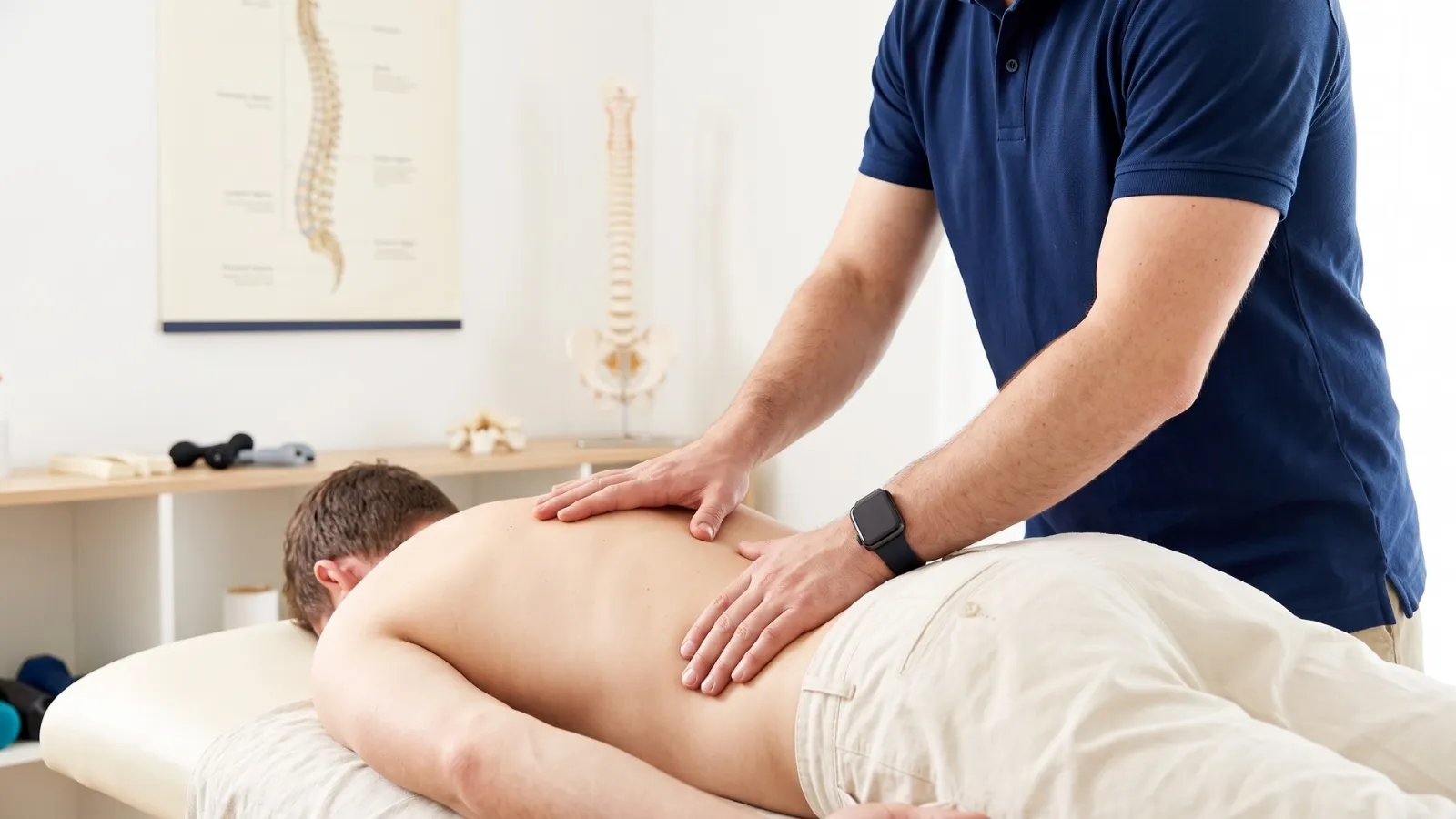
Physiotherapy holds a central place in the treatment of spondylolisthesis, and the logic is clear. At the level of the slipped vertebra, the deep muscles that control that segment (the deep muscle of the abdominal wall and the multifidus muscles wrapping the spine) often fail to engage enough, or in time. One of physiotherapy’s core aims is to retrain these deep muscles so the slipped segment gains what is almost an “internal support” and control — this is called stabilisation work, and it stands among the most strongly evidenced approaches in treating spondylolisthesis. Alongside it come work to balance the flexibility of the back and hips (especially easing tightness in the hamstrings and hip muscles), manual therapy, and an individualised, graded strengthening programme. The goal is not to “push the slip back” — that is usually not the aim — but to make the back strong, balanced and pain-free despite the slip. For an overview of the lower back and the treatment approach, see the Lower Back Pain page.
What should be avoided?
In spondylolisthesis, some movements can stress the slipped segment more, so they are areas that call for care. Chief among them is repeatedly bending the back into excessive extension (hyperextension), because this movement tends to increase the force pushing the slipped vertebra forward. Likewise, lifting heavy loads with poor technique, and activities that put high-impact, jarring loads through the back, can stress the segment. This does not mean “don’t move” or “live restricted forever”; on the contrary, correct exercise done while keeping the back in a neutral position and progressing gradually is the most effective way to protect this very segment. Which movements suit you is determined through assessment.
How are exercises chosen?
In spondylolisthesis, there is no such thing as “the same exercise for everyone”. The right exercise is chosen according to the type of slip, its grade, whether it is stable, and which movements ease or aggravate the person. The general tendency is to steer away from movements that bend the back into excessive extension, and to emphasise work that builds neutral spine control and deep stabilisation. But even this general frame is tailored to the person; the exercise programme is based on assessment and updated according to the person’s response over time.
What is recovery like?
The natural course of spondylolisthesis is generally favourable, especially in low-grade, stable slips. The effects of a structured physiotherapy programme are often felt within a few weeks; truly making the back strong and resilient, however, is a graded process that can take a few months depending on the person. What matters is that this process is run not as a race to “correct the slip”, but with the goal of returning the person to a pain-free, safe and active life. Managed well, many people with spondylolisthesis lead full, active lives.
When is surgery considered?
In spondylolisthesis, the first and often sufficient approach is conservative treatment; the great majority is managed without surgery. Surgery, in turn, can be considered as an option in certain situations: a high-grade slip or one progressing over time, marked and progressive nerve symptoms (such as increasing muscle weakness), or symptoms that persist despite proper conservative treatment applied for an adequate period. This evaluation looks at the slip’s grade, its angle, whether it is progressing and the neurological picture — and it is a decision made by a doctor who sees the person as a whole. The purpose of this article is not to direct that decision, but to show how strong a first option the conservative path is for most people.
When is assessment needed?
If you have pain in your lower back that has not settled after a few weeks, keeps worsening or restricts your daily life, a physiotherapy assessment clarifies what the picture is and which programme suits you. If the pain is accompanied by marked, progressively increasing weakness spreading into the legs, or changes in bladder or bowel control, this calls for an earlier and more careful assessment. Such symptoms are rare, but it is important to have them assessed in time.
References
- Spondylolisthesis — StatPearls / NCBI (PMC)
- Lumbar Spondylolisthesis: State of the Art on Assessment and Conservative Treatment — PMC Masterclass
- Stabilization Exercises in Degenerative Spondylolisthesis — Physical Therapy (Oxford, RCT)
- Spondylolisthesis — Physiopedia
Frequently Asked Questions
Does a slipped vertebra require surgery?
Most of the time, no. The great majority of spondylolisthesis — especially low-grade slips — is managed without surgery, through physiotherapy. Surgery is considered only in selected situations, such as a high-grade or progressing slip or marked nerve symptoms, and is assessed by a doctor.
I have a slipped vertebra — can I still do sport?
In most cases yes, but of the right kind. Activities that repeatedly bend the back into extension and high-impact loading call for care; graded work that keeps the spine in a controlled, neutral position is preferred instead. The right activity for you is determined through assessment.
Will the slip get worse over time?
Most low-grade, stable slips do not progress markedly over time. Even so, especially if symptoms change, regular follow-up and the right programme provide both safety and comfort.
Which exercises should I avoid with a slipped vertebra?
In general, movements that repeatedly bend the back into excessive extension (such as some backward-stretching exercises) call for care. But this varies from person to person; the right exercise choices become clear through a physiotherapy assessment.
You can book an appointment to assess your lower back and discuss suitable treatment options.
Related Posts

What Is Lumbar Spinal Stenosis? A Physiotherapist's Complete Guide
Lumbar spinal stenosis is usually managed without surgery. Leg pain worse with walking, relieved by bending forward, exercise, and when surgery is considered.
Can a Herniated Disc Heal Without Surgery? A Physiotherapist's Complete Guide
Can a herniated disc heal without surgery? Studies show most improve with conservative care. Symptoms, treatment, exercise, recovery and when surgery is needed.

What Is Sacroiliac Joint Pain? The Condition Often Mistaken for Back Pain
Sacroiliac joint pain is often confused with a herniated disc or sciatica. Its symptoms, how it differs from back pain, diagnosis and the role of physiotherapy.
This content is for informational purposes only. It is not intended as medical advice. Please consult your physician and physiotherapist for any health concerns.